
The debate around Freelancers vs Marketing Agencies usually begins when marketing stops being something you can manage casually between meetings, emails, and daily operations, because once results matter, scattered effort usually stops working.
At first, hiring a freelancer feels practical because one person, one conversation, and one invoice sounds easier than dealing with a full agency structure that may look heavier than necessary.
Then the real questions start showing up, because marketing is rarely one task for very long, and one campaign often creates another need that nobody planned for two weeks earlier.
A paid campaign needs landing pages, those pages need stronger copy, stronger copy needs search visibility, and search visibility needs technical fixes that someone has to own properly.
That is usually the moment businesses realize they are not choosing between two prices, but between two ways of carrying responsibility when growth starts, depending on consistent execution.
Some companies stay lean with independent specialists for years and do well, while others hit a wall quickly because too many moving parts start competing for attention.
The better choice usually depends on how much coordination your business already needs, not how attractive the cheaper invoice looks during the first month.
What Hiring a Freelancer Actually Feels Like
Where Freelancers Usually Deliver Their Best Work
What Agencies Usually Bring That Freelancers Cannot Easily Replicate
Why Agency Structure Often Feels More Stable Over Time
Comparison Table: Freelancers and Agencies Side by Side
| Factor | Freelancers | Marketing Agencies |
| Cost at Start | Usually lower | Usually higher |
| Communication | Directly with one person | Structured through the team |
| Skill Range | Narrower | Broader |
| Availability | Depends on one person | Shared team continuity |
| Reporting | Often simple | Usually structured |
| Scalability | Limited by capacity | Easier to expand |
| Risk | Higher dependency | Shared responsibility |
Why Businesses Still Prefer Freelancers First
- Communication feels easier because there is usually one direct point of contact.
- Costs stay lighter during short projects or temporary support periods.
- Hiring can happen quickly without long internal discussions.
- Specific expertise can be chosen for one defined task.
- Small revisions often move faster when fewer people are involved.
Where Freelancers Start Becoming Difficult to Scale
The challenge usually appears when one solved problem immediately reveals two new ones that need attention at the same time. A business may hire someone for search work, then realize technical fixes, content updates, and reporting also need stronger ownership.
That becomes especially clear when comparing SEO outsourcing vs in-house SEO because SEO rarely stays limited to one specialist for very long.
Search performance often depends on development, content quality, internal linking, speed, and analytics working together. One freelancer may cover some of that, but rarely all of it with equal consistency. At that stage, coordination itself becomes another task someone inside the business must manage carefully.
Why Agencies Often Make Growth Easier to Manage
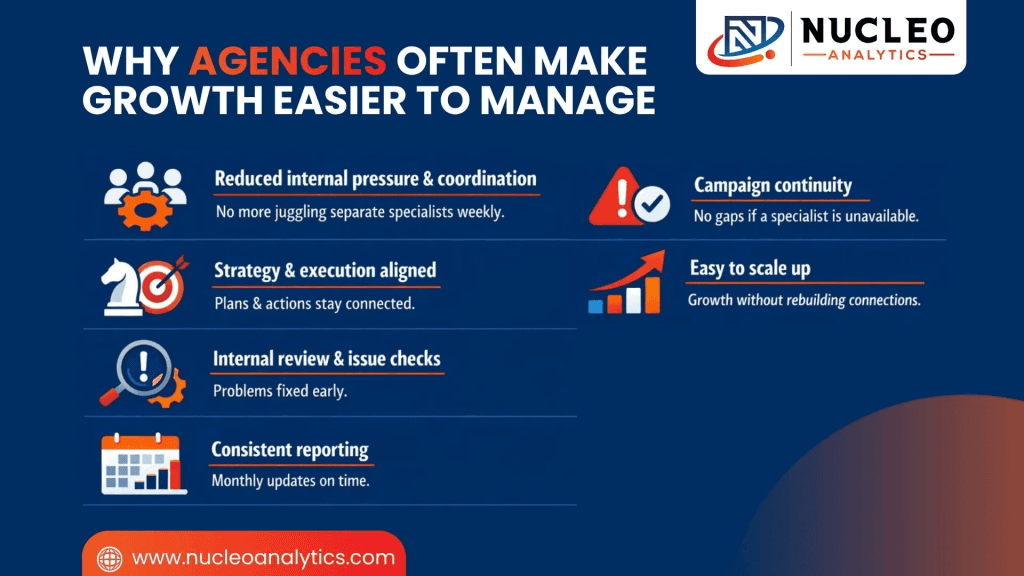
- Strategy and execution usually stay connected instead of being handled separately.
- Internal review catches issues before they affect campaign performance.
- Reporting follows a predictable monthly rhythm.
- Campaigns continue even when one specialist becomes unavailable.
- Scaling happens without rebuilding external relationships.
Not Sure If Your Website Is Ready for Ai-Driven Search Visibility?
Where Agencies Can Feel Frustrating at First
Agencies are not automatically easier, especially when a business only needs one quick task completed without larger planning around it.
A simple update can feel slower because agency workflow often includes internal review, approvals, and documented communication before delivery happens. This is why some businesses hesitate when reviewing marketing agency outsourcing services during earlier growth stages.
The pricing often reflects access to systems, not just one immediate deliverable. That can feel expensive if the business only uses a small portion of available support each month. Still, those systems usually become useful once work starts affecting several channels together.
Which Option Usually Fits Startups Better
Startups usually prefer freelancers first because early priorities change quickly, and financial flexibility matters more than formal structure. One month may require ad support, while the next month suddenly becomes technical cleanup or content improvement.
Projects such as outsource WordPress development often begin with freelancers because the task stays specific and short enough to manage directly. That keeps spending tighter while the business still figures out what actually drives traction. The model works well while operations remain light and decisions happen fast. It becomes harder only when several needs begin arriving together.
Which Option Usually Fits Growing Businesses Better
Growing businesses usually hit a point where disconnected marketing support starts slowing decision making more than helping it. Paid traffic, search visibility, content planning, and technical fixes begin affecting each other every single month.
That is where the broader freelancer vs marketing agency question usually becomes impossible to ignore. Leadership often needs one system that explains what is happening instead of several contributors explaining separate pieces.
That clarity matters because growth usually increases decision pressure across departments. At that stage, coordination itself becomes part of marketing performance.
How Cost Should Be Judged Honestly
A cheaper monthly invoice looks good only until weak execution starts creating delays, repeated revisions, and missed opportunities that cost more later. Freelancers may cost less upfront, but an incomplete strategy often pushes businesses into additional spending they did not expect three months earlier.
Agencies usually charge more because planning, review, reporting, technical oversight, and execution happen through several people.
That means cost should always be judged against total business impact, not isolated monthly pricing. The lower fee does not automatically create lower long term cost. That is where many early hiring decisions quietly go wrong.
Why Some Businesses Eventually Use Both Models Together
Many businesses eventually stop treating this as one permanent choice and build a hybrid setup that uses both, where each works best. An agency may own a strategy and reporting, while freelancers support smaller, specialist work that does not require broader coordination. That model works only when ownership stays extremely clear, and nobody overlaps responsibilities carelessly.
Without clarity, duplicated effort starts appearing faster than expected. That usually creates confusion before anyone notices wasted time. A hybrid model works best when leadership already manages projects carefully.
How Nucleo Analytics Helps Businesses Choose More Clearly
Nucleo Analytics usually starts by looking at where the current friction actually exists instead of pushing one model immediately. Some businesses only need one strong specialist because the strategy already exists internally, and execution is the weak point.
Others already need broader coordination because too many marketing parts now affect each other every week. Nucleo Analytics focuses on matching support to that reality so businesses avoid paying for the wrong structure.
That usually saves more money than chasing the cheapest option first. A clearer decision early often prevents months of correction later.
Conclusion: The Better Choice Depends on What Your Business Is Carrying Right Now
There is no universal winner because both options work well when matched to the right business stage and internal reality. Freelancers work best when needs stay narrow, communication must stay fast, and internal leadership already knows what direction matters most. Agencies become stronger when growth depends on systems, reporting, and coordinated execution across several moving parts.
Nucleo Analytics helps businesses figure out that difference before money gets wasted on the wrong support model. If marketing already feels harder to manage than it did six months ago, that usually means the structure deserves another look.
Conclusion: The Better Choice Depends on What Your Business Is Carrying Right Now
There is no universal winner because both options work well when matched to the right business stage and internal reality. Freelancers work best when needs stay narrow, communication must stay fast, and internal leadership already knows what direction matters most. Agencies become stronger when growth depends on systems, reporting, and coordinated execution across several moving parts.
Nucleo Analytics helps businesses figure out that difference before money gets wasted on the wrong support model. If marketing already feels harder to manage than it did six months ago, that usually means the structure deserves another look.